Two bodies face to face
two waves are sometimes
and night is an ocean.
Two bodies face to face
are often two stones
and the desert night.
Two bodies face to face
roots are sometimes
Joined in the night.
Two bodies face to face
are often blade
and night lightning.
Octavio Paz
January 24, 2011

January 07, 2011
I Love
I love to see you smile
and I love knowing that
I caused that smile.
I love see you happy
and I love knowing that
I caused that happiness.
I love to look into your beautiful eyes
and I love the way I fall into them.
I love it when you hold my hand
and I love having
the courage to grab and hold yours.
I love that I want to be yours
I love so many things about you
but the most important thing is…
I LOVE YOU.
and I love knowing that
I caused that smile.
I love see you happy
and I love knowing that
I caused that happiness.
I love to look into your beautiful eyes
and I love the way I fall into them.
I love it when you hold my hand
and I love having
the courage to grab and hold yours.
I love that I want to be yours
I love so many things about you
but the most important thing is…
I LOVE YOU.
August 22, 2009
La Vega, rich and diverse

Despite not being lined with beautiful beaches and luxurious resorts, La Vega remains one of the cities with greater attraction for domestic tourists for Dominicans. Within its territorial extension of about 2.287 square kilometers, the province interesting hidden treasures and historical stories, perhaps envied by anyone who feels pride in his homeland. Cheerful and helpful people, so much so that once a signature liquor was motivated by highlighting its benefits through the quaint phrase: "In all Lavega're good, we are all happy, you know ..." The Vega has an exuberant nature, numerous rivers and two major cities: Constanza and Jarabacoa, nestled in the hills of the Cordillera Central, more than 500 meters above sea level. It's a town that has preserved many traditions. Its people still share the simple place under the shadow of an old and generous flamboyant or simply trying to encourage their faith by the Catholic religion, after a promise to walk barefoot up the hill of Santo Cerro, one of the country's most important shrines.
For the number of athletes that has "calved" this land was called "Olympic City". But it has not only been the cradle of outstanding athletes, but there were born leading journalists, doctors, artists, writers and presidents, as is the case of Juan Bosch. As you quote the book "Fragments of fatherland", issued by the Reserve Bank, one of the treasures of this town is La Vega Vieja, which was destroyed by a violent earthquake, leaving very little standing in what was his outstanding architecture. La Vega Vieja was declared a National Historic Park next to Holy Hill in 1977. According to data within their treasures La Vega Vieja La Fortaleza La Concepcion has a strong name, the Franciscan monastery and two cemeteries. it cites the book that has a cistern, several furniture and decorative objects such as candlesticks, crucifixes, cutlery, pottery, thimbles, needles and plant decorations.
In 1795, La Vega was a vast territory and was divided into the following parishes: Cotuí, Bonao, Samana, Sabana de la Mar, Moca, San Francisco de Macoris and Angelina. With this factor, I have an idea how big this territory. According to "Fragments of country", the cult of the Virgin of Las Mercedes is the largest cultural expression that arises from the province of La Vega. This city is located in the Central Cibao region. An important part of the province belongs to the so-called Cibao Valley or La Vega Real. It is one of the oldest cities in the continent, founded in 1495. Its soil is very fertile, is devoted primarily to the production of rice, potatoes, garlic, cassava, red beans, bananas, vegetables and flowers. In the area, livestock, took one of the most important positions nationwide. The Dominican carnival which has not really heard of vegan carnival. This festival is a tradition not only for vegans, but also for inhabitants of other nearby villages and especially the capital. Considered the most ornate and elegant in the country, this carnival is held every week in February of fines in the Parque de las Flores.
Jarabacoa and Constanza own light shine Jarabacoa and Constanza are two cities that despite belonging to La Vega own light shine. Jarabacoa is known for its mountain tourism in the growth process. Their idyllic landscape has inspired entrepreneurs, artists and institutions to build on her summer houses or tourist cabins that ultimately contribute to further beautify the area. Jarabacoa Constanza Both are scenarios to delight for its spas, rivers, waterfalls and valleys. Each is especially the freshness of its climate, which makes them more temperate areas of the country. According to the Tourism Ministry, in February 2002 in La Vega had about 25 hotels, with a bid of 450 rooms. La Virgen de Las Mercedes On 24 March 1495 in La Vega was a battle that had much significance in the history of the island. This is the battle of La Vega Real, waged by the Spanish army, commanded by Christopher Columbus. Legend has it that the night before the battle appeared in the camp of the Spanish Virgin of Las Mercedes, which would have guaranteed them victory in the war. Since then the country started in the cult of the Virgin of Las Mercedes, which is considered the patroness of the Dominican Republic. Popular Holidays Fragments As explained homeland, La Vega is special veneration of three virgins and that there are two parties employers: the Immaculate Conception, which culminates on December 8 (which also takes place in the municipalities of Cotuí, Ramon Santana and hat Peravia province), and Nuestra Señora de la Antigua, which culminates on 16 August (which also held in the town of Jarabacoa).
August 21, 2009
Dominican Republic and Costa Rica: What the happiest people in the world have in common
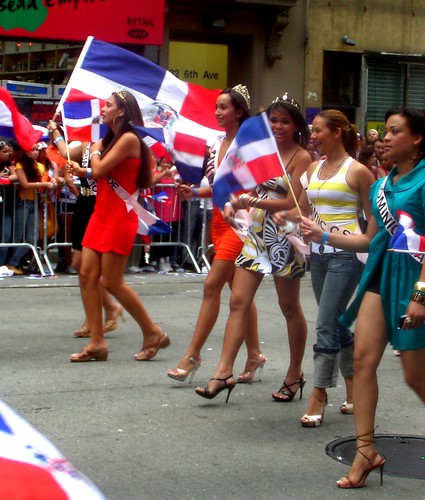
The lazy days of Summer are a good time to read. I had just finished Dr. Juan Bosch's classic "Composición Social Dominicana:História e Interpretación", when I was caught by surprise that a European think-tank had selected Dominicans the second "Happiest People" in the world and Costa Ricans number one. Was there a common bond?
Having just read the book on over 500 years of history picked my interest. What could these two outwardly different countries have in common that a travel agent would not normally place them in the same tour destination, simply for logistical reasons.
With the risk of sounding pretentious, I humbly took on the challenge of finding out what made these two apparently different peoples extraordinarily happy.
And why not, my challenge was stimulated and emboldened by several factors: First, I was fortunate to have studied Latin American anthropology at Mexico's Ibero-Americana University. Anthropologists look at people's real differences which are social customs and habits, not outside skin chromaticity.
Secondly, I felt I had been a witness to history when at the home of Don José Desiderio Ares Maldonado and Doña Clément Guzmán de Ares, I had spent two days informally speaking (or interviewing) the famous Don José Figueres.
Don "Pepe" as the former Costa Rican President was known, had been a house guest of the Ares-Guzman family for the 1978 Presidential inauguration of Don Antonio Guzmán. I studied President José Figueres in College and knew of his great leadership during the 1948 Revolution, and eventually became known as the Founder of the New Costa Rica.
Lastly, I had a more mundane reason. I had spent a year training and supervising Costa Ricans. Unless you know the ropes and look for customs and habits, it's a tough job for anyone; specially for a Dominican from New York as I was. But the same could be true when dealing with the elite of Port-au-Prince who can think of themselves as the "crème-de-la-crème".
Now for similarities. First, Dominicans and Costa Ricans have a mental sense of superiority, false or not, of thinking they live with or their country is filled with "inferior" foreign people.
Ask a Costa Rican the population of their country and they'll answer..."4 million". However, one million of those are illegal Nicaraguans. Ask Dominicans the country's population and you'll get: "10 million... but 3 million are illegal Haitians.
Additionally, inhabitants of their respective Capitals see themselves as highly cosmopolitan. They claim to know New York City better than well-educated middle class New Yorkers with financial means. They'll (try to) challenge you on knowing the best restaurants.
I think it goes back to a "state of mind", the culprit being a Spanish tradition that permeates all Latin America, perhaps more than Madrid itself by having a disdain for manual labor and a thinking of yourself as "Caballero" (Gentleman on horseback). In terms of the wardrobe, male inhabitants delight in wearing suits, which is comfortable in San Jose's weather and uncomfortable yet obligatory in Santo Domingo despite the heat.
Now for the fallacies, and here they have similarities.
Cost Ricans consider their country the 'Switzerland of Central America". They claim no standing Army, yet they have numerous private security services.
Dominicans for years have had no enemy with military might - yet the country maintains a "Cold War" military apparatus.
And lest we forget, the ostensibly pious Costa Ricans at one time had two fugitive ex-Presidents on corruption issues.
Finally, I agree with the study of the New Economics Foundation. Both countries value and care for their environment. Both peoples have an enormous high opinion of themselves, combined with having unwanted illegal neighbors contributing poverty without much intellectual skills. Both countries doggedly compare themselves to the United States, and yes, nature conservation is important, a big plus.
Combine these factors with the Spanish tradition of a "better than thou attitude" man-on-horseback mentality, it all comes down to a state of mind if you "think" you are better than the rest - and you'll be happy- specially when you have poor neighbors to remind you how fortunate you are. Even if you're hungry. Just don't show it.
De José C. Paulino
June 12, 2009
Judge Sonia Sotomayor: defending our first Latin to the United States Supreme Cour

US. - The United States Supreme Court is the highest court of the land. It is composed of nine judges. Despite the fact that half of the states of the United States have Spanish cultural heritage and influence since the 1500's - no Hispanic or Latino has ever served as a Supreme Court Justice - although Latinos are now the largest so-called minority, and growing.
However a big controversy arose when Bronx Puerto Rican nominee Sonia Sotomayor said in a 2001 speech that "a wise Latino woman with the richness of her experience would more often that not reach a better conclusion than a white male that hasn't lived that life". Many of us agree. So let's "drill down" to the South Bronx with that statement. I for one do not remember too many "white Anglo males" living and struggling in the South Bronx in recent years. I should know.
I had the the distinct honor and privilege of serving as President of School Board District #7 , which is located in the heart of the South Bronx, and is also the neighborhood where Judge Sonia Sotomayor was born and raised.
Hey, the South Bronx is a tough, hard, tempting place with many a good people, just plenty of bad Press.
For one, Sonia's mother worked two jobs after her father died to send her to private schools. Young Sonia subsequently graduated Summa Cum Laude from Princeton University. As an Ivy-parent that fact alone impressed me. Princeton was traditionally known as a "Southern Plantation" principally because it was the last "Ivy University" to accept African-Americans after years of resistance. And once had a President who was a member of the Ku Klux Klan. Wow !!! , can you believe that ?
Jude Sotomayor writes how she felt she was in a strange planet while at Princeton. Better still for you to have a better taste the place, just read Otis Graham's book "Member of the Club" and learn his experience at Princeton.
When I see her limping around on Television with a big smile with crutches on her broken ankle persuading Senators - really makes one think "Pobrecita", the things a "Poor little girl form the South Bronx has to do to be approved to the Supreme Court. The President's nomination not withstanding.
However my beef also with conservatives is their amnesia of the famous Puerto Rican 65th Infantry and how Puerto Ricans earned their place in the "American Sun" by proudly serving and contributing their youth's "Blood Tax" to two American conflicts - WW II and the Korean War - while enduring discrimination similar to Mexican-American soldiers along the way.
In closing I learned from South Bronx parents - to be a plain speaker. To be sincere, to speak honestly with no "bull".
So to those narrow-minded folks who oppose the appointment of Judge Sotomayor I ask them to read the words of Supreme Court Justice Samuel Alito, the Italian-American who said upon his nomination to the Supreme Court the following words -" when I get a case about discrimination I have to think how my own family suffered discrimination". Judge Sonia Sotomayor can easily identify with these words.
Our time has arrived, let's support the first Latina to the Supreme Court of the United States.
De José del C. Paulino
Subscribe to:
Posts (Atom)